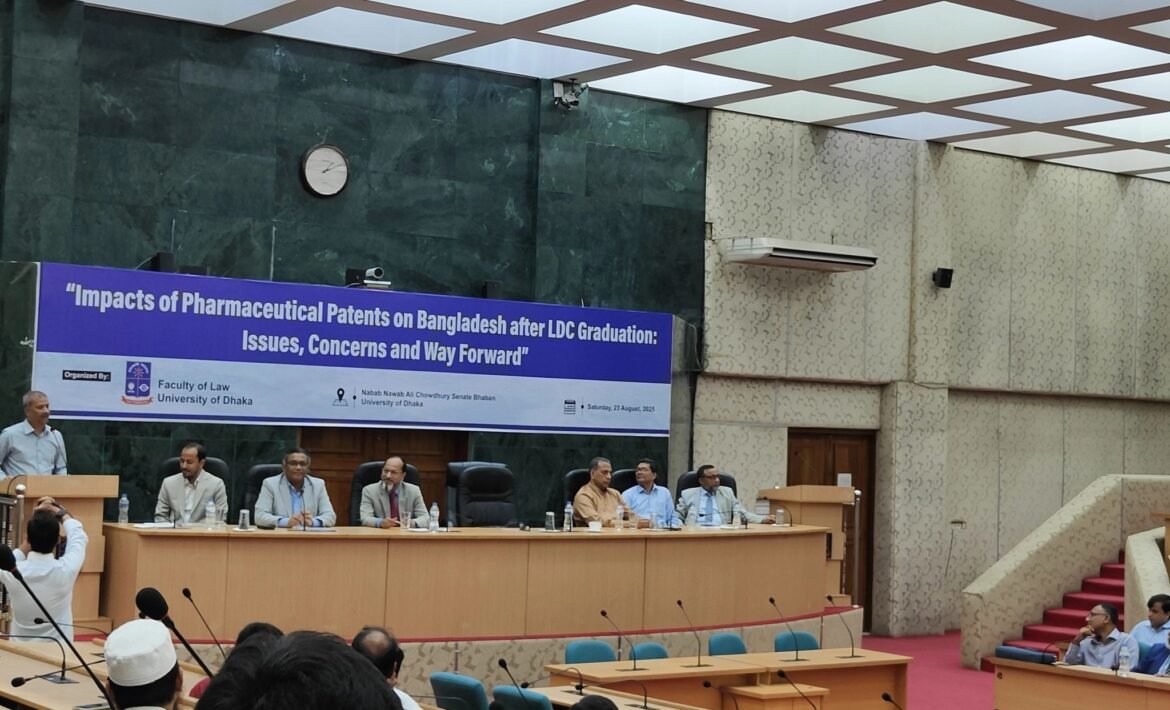
LDC Graduation and Pharmaceutical Patent
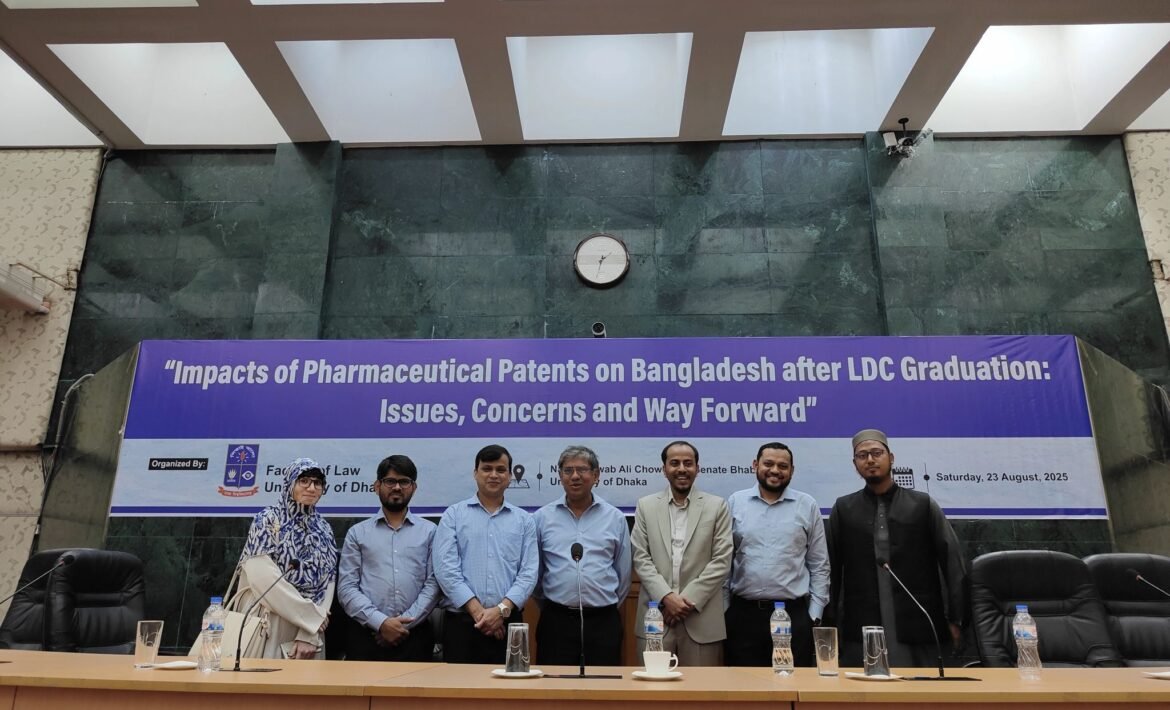
Pharmaceutical Patents: The representatives of the pharmaceutical companies in Bangladesh, IP experts, professional, practitioners, and students from the Department of Law, University of Dhaka participated in this seminar.
IP experts discussed the challenge, concerns and way forward for the pharmaceutical companies in Bangladesh after LDC graduation. Pharmaceutical companies in Bangladesh produce approximately 80% of generic medicines, and the remaining 20% are patented drugs. After LDC graduation, Pharmaceutical companies will not face any challenges for producing generic drugs, but they will face challenges for non-expiration of the term of the patented drugs applied before LDC graduation and new drug applications that will be filed after LDC graduation.
To overcome these challenges, the Bangladesh Patent Act, 2022 was enacted and subsequently, repealed and new Bangladesh Patent Act, 2023 was enacted to mitigate the challenges for the pharmaceutical companies in Bangladesh. Thus, the Bangladesh Patent Act, 2023 provides the provisions for the Voluntary Licenses, Compulsory License, Parallel Importation, and Bolar exception, which will mitigate the challenges for the pharmaceutical companies in Bangladesh.
section 35 of the Patent Act, 2023 provides that patents granted do not impede protection of public health and nutrition and should act as an instrument to promote public interest, especially in sectors of vital importance for socio-economic and technological development of Bangladesh and do not in any way prohibit the Government from taking measures to protect public health;
section 36 of the Patent Act, 2023 provides the provisions for issuing the compulsory licenses which can be granted for the following grounds:
- public interest, particularly national security, nutrition, health, or the development of the national economy;
- the court decides that the patent is being used as anti-competitive manner;
- misuse of the patent;
- failing to meet the reasonable requirements;
- not affordable to the public;
- failing to show the inventions is feasible to manufacture in Bangladesh;
- second patent in concerned with the claim of the first patent cannot be used without violating the first patent;
- refusing to grant license within four months; and
- access to an essential service.
on the above-mentioned grounds, the Director General may grant compulsory license to such person on terms and conditions.
The applicant for a compulsory license shall file an application to obtain a license from the patentee on reasonable commercial terms and conditions. If the application is not granted within a reasonable period of time, then the said provision will not apply to any decision made under clause (b) of sub-section (1). It is applied for on the ground of failure to work or insufficient working before the expiration of a period of 4 (four) years from the date of filing of the patent application, or 3 (three) years from the date of the grant of the patent, whichever period expires last.
the compulsory license is not be refused unless the patentee justifies his inaction by legitimate reasons. It shall be non–exclusive and non-transferable. Except with that part of the enterprise or goodwill which exploits such license. Use of invention under the compulsory license shall be predominantly to supply to the domestic market, unless the compulsory license is granted to remedy anti-competitive practice or under section 39 to export the product to a foreign country not capable of producing or not capable of producing the said item sufficiently.
In case of semi-conductor technology, it is to be granted by the Director General only for non-commercial purpose or in cases where the Court or any other legally constituted body for this purpose deems fit and proper that the process of using the patent may be anti-competitive by its proprietor or licensee.
If the government is further satisfied that granting of a license not being a compulsory license may be a sufficient remedy in terms of customs, license shall be granted in such circumstances.